Media expert Antony Young rounds up media news from beyond Aotearoa in a regular column for StopPress.
This week:
- PetSmart’s response to viral joke a “buzzkill”, rather than brand win.
- Swedish IAB dumps Meta.
- Microdramas are becoming the new branded-content test bed.
- Nielsen’s February Gauge set to put linear TV back on top.
- TikTok deal set to create a windfall for the US Government.
- Customer reviews become AI search fuel.
PetSmart fumbles a viral gift
When the internet hands a brand a joke, the real risk is trying to control it too early.
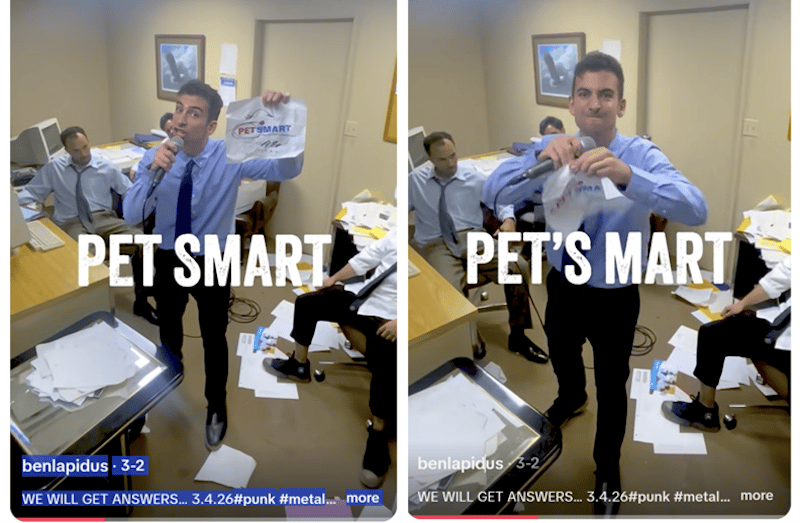
PetSmart has landed in the middle of a social case study moment after trying to answer, rather than play with, creator Ben Lapidus’ viral “Pet Smart” versus “Pet’s Mart” joke.
Lapidus turned the long-running name debate into a heavy-metal bit. It then snowballed, gaining nearly 40 million views across TikTok and Instagram and a three-minute follow-up on YouTube. There was also a parking-lot “Rally for Truth” in Sherman Oaks, and even appearances from John Legend and Chrissy Teigen.
PetSmart joined in, but with a flat “It’s Pet Smart. Case closed,” which TikTok users read as a buzzkill rather than a brand win. Comments summed it up well: “Could of cooked but instead you microwaved.”
Instagram was warmer, but the split reaction exposed a familiar issue for brands trying to move at creator speed. Social strategists argue the miss was not joining the trend but joining it on the wrong terms then ending the joke instead of upping the ante.
Swedish IAB dumps Meta
The Swedish IAB spent months pressing Meta for evidence it was tackling scam ads, then lost patience after Reuters reported the company may have taken in as much as $16bn from scammers and banned-goods advertisers in 2024, with internal systems allegedly charging bad actors more rather than blocking them.
Meta says it removed 134 million scam ads in 2025 and disputes the revenue figure, but that wasn’t enough for Sweden’s board, which voted to revoke both its board seat and membership. Now IAB divisions in the UK, US and Australia are under pressure to explain why Meta still holds influence there.
Brands buy into microdramas
Brands are turning microdramas into the latest branded-content test bed, betting that vertical soap-style series can do what most branded entertainment struggles to: get watched.
P&G, Crocs, Maybelline and JCPenney are now building products directly into short-form episodic plots made for phones. Crocs’ five-part ReelShort series, Charmed to Meet You, pulled 7.8 million views in three weeks. Meanwhile, P&G charged up to $9.99 to unlock all of The Golden Pear Affair. The pitch is obvious: microdramas are cheap by entertainment standards, costing around $200,000 on average, according to Pixie USA.
They are also quick to make, and built for scroll-stopping cliffhangers. The catch is whether US audiences will keep downloading niche apps and paying for content that often looks closer to telenovela camp than premium streaming.

Nielsen’s TV ratings reset scrambles upfronts
Just as streaming looked ready to claim permanent bragging rights, Nielsen’s delayed February Gauge is set to put linear TV back on top – at least on paper.
Using a new demographic data source from the Advertising Research Foundation, Nielsen now says streaming accounted for 41.9% of US TV viewing in February versus 47.4% for broadcast and cable combined. It’s a sharp reversal from January’s reported 47% streaming share.
Streamers reportedly pushed Nielsen for more detail, prompting a one-week delay to the report just as upfront and newfront negotiations heat up.

TikTok fee turns heads
A US-controlled TikTok deal is due to land a windfall for the US Government. Investors are reportedly set to pay $10 billion to the US Treasury as a transaction fee tied to the government’s role in getting the deal done.
Oracle, MGX and Silver Lake are among the investors said to be involved. Part of the fee was reportedly already paid when the deal closed in January.
Reviews become AI search fuel
Customer reviews are becoming an old-school tactic with new urgency as brands realise ChatGPT, Perplexity and other AI discovery tools are using them to shape product recommendations.
Modern Retail reports Fireclay Tile has become “more deliberate” about review collection after seeing ChatGPT surface it as the “best DTC tile company in California, based on reviews”. Meanwhile dog food brand Pawco now offers $20 off after a third order if customers leave feedback.
The logic is simple: reviews give LLMs rich, specific language about product quality, trust and use cases, and that matters as shoppers increasingly ask AI what to buy instead of Googling it.
US ChatGPT users are already making more than 84 million shopping-related queries a week.
The twist is that it is not just about having reviews, but where they live. Brands are pushing for testimonials across their own sites and public platforms like Reddit, Yelp and Tripadvisor. This is because AI systems tend to pull from some sources more easily than others.