Media expert Antony Young rounds up media news from beyond Aotearoa in a regular column for StopPress.
This week:
- Lynx has unveiled a scratch-and-sniff billboard, with reactions ranging from nostalgic delight to hygiene scepticism.
- Influencer marketing is under scrutiny as the trust gap between consumers and influencers grows.
- Meta plans to fully automate ad creation and targeting with AI by the end of 2026.
- YouTube now holds a record 12.4% share of US TV viewing, cementing its dominance in American living rooms.
- The Supreme Court rejected Lerner & Rowe’s case, ending their legal fight over name use in search ads.
- NPR and Colorado stations are suing over Trump’s order to cut funding from “biased media.”
- Omnicom is unifying all staff under “@omc.com” to streamline systems and boost security.
Does Lynx’s latest billboard ad past the smell test?
Unilever UK has launched a cheeky scratch-and-sniff billboard campaign for Lynx spray for men’s er, lower body parts, inviting pedestrians to “smell the attraction” by physically engaging with scented ads across major cities.
The campaign has sparked both amusement and mild concern, with reactions ranging from nostalgic delight to hygiene scepticism.
The billboards have gone viral on social media, despite some critics questioning the wisdom of encouraging strangers to sniff public surfaces.
Influencer marketing under scrutiny in new study
Despite major global marketers doubling down on influencer marketing, a growing trust gap is emerging between consumers and influencers.
71% of consumers regretted purchases based on influencer recommendations and only 33% believed influencers actually use the products they promote.
This scepticism is driven by perceptions of inauthenticity, lack of transparency and overly curated content.
Relatability is key: 40% of consumers say it’s the main reason they trust an influencer. While 81% of influencers now use AI in content creation, 35% of consumers distrust AI-generated content, and 61% want its use clearly disclosed.
Compounding the issue, 56% of influencers admit to promoting products they don’t genuinely like, and 33% have purchased fake followers or engagement.
Mark Zuckerberg wants to entirely replace agencies with AI
Watch out agencies – Zuckerberg wants to replace you!
Meta is aiming to overhaul the entire advertising process on its platforms by fully automating ad creation and targeting with AI by the end of 2026.
Under Mark Zuckerberg’s vision, businesses will simply provide a product image and budget, and Meta’s AI will generate the entire campaign – visuals, text, video, audience targeting and budget recommendations – while also personalising ads in real time based on user data like location.
This ambitious shift aims to make ad creation accessible for small businesses and eliminate the need for traditional production.
YouTube is now the number 1 broadcaster on US TV
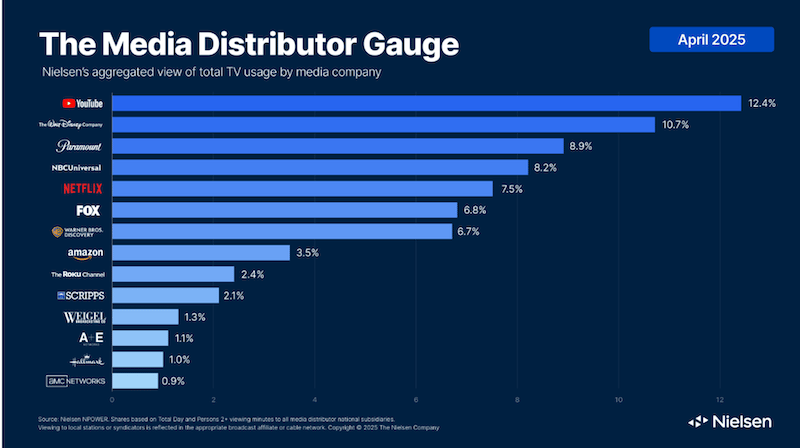
How the TV world has changed. YouTube has cemented its dominance in American living rooms. It tops Nielsen’s April 2025 Media Distributor Gauge Report for the third consecutive month with a record 12.4% share of US TV viewing – up from 9.6% a year ago.
This growth reflects YouTube’s expanding influence, and several strategies it’s instigated to increase its audience over the past several years. This includes integrating subscriptions to premium streaming services, acquiring exclusive sports content like NFL Sunday Ticket, and pushing popular formats like Shorts and video podcasts.
Disney (ABC, ESPN, Disney channel) followed with 10.7%, buoyed by ESPN coverage, while Paramount (CBS, Showtime, Nickelodeon, MTV, Comedy Central) came in third at 8.9%, showing the largest monthly gain due to CBS viewership increases.
Netflix and Amazon were ranked 5th and 8th in viewership rankings respectively. Last week, I reported that streaming now accounts for 43.8% of U.S. TV time.
US Courts rule it’s OK to buy competitor brand name search ads
The Supreme Court has declined to hear a case brought by personal injury firm Lerner & Rowe, effectively ending their years-long legal battle against rival Accident Law Group over the use of their name in search engine advertising.
Lerner & Rowe claimed trademark infringement, arguing that Accident Law Group’s use of their brand name to trigger Google search ads confused consumers – a theory supported, they said, by 236 phone calls referencing their firm.
But lower courts weren’t convinced, pointing out that 236 confused callers out of over 100,000 ad impressions hardly proved mass deception, especially given today’s digitally savvy consumers and Google’s clear results layout.
The 9th Circuit noted keyword advertising is a common, competitive practice – a view the high court let stand.
Experts claim NPR has strong case to sue Trump
Meanwhile in another court case US public broadcasters NPR and three Colorado radio stations have filed a lawsuit challenging Donald Trump’s executive order cutting federal funding to what he labelled “biased media,” arguing it violates First Amendment protections.
The order, signed on May 1, 2025, threatens to defund NPR and PBS over coverage the Trump administration deems left-leaning or critical, particularly on issues like LGBTQ+ rights.
Legal experts say Trump’s openly stated motives could strengthen NPR’s case, as the suit frames the action as unconstitutional viewpoint-based retaliation.
This is part of a broader media crackdown during Trump’s second term, including banning the Associated Press from key press access for refusing to use the term “Gulf of America,” suing CBS’s parent company for $10 billion over an allegedly edited Kamala Harris interview and targeting the Des Moines Register for publishing pre-election polling unfavourable to Trump.
NPR CEO Katherine Maher said the lawsuit is driven not by politics, but by a “matter of necessity and principle,” defending press freedom as foundational to democracy.
Omnicom ditches individual agency email accounts
New Zealand agencies that are involved in the Omnicom and IPG merger will I’m sure noticed last week’s announcement by Omnicom that it will transition all 74,900 employees across its global network to a single unified email domain, “@omc.com”.
The marketing services holding company claims this won’t affect the distinct identities of each individual agency networks, such as BBDO, DDB, OMD, or PHD, but will streamline IT systems, improve data security and enhance internal collaboration.
Wow – if only an email address had that much power!