Get the latest direct to your inbox twice a week. Sign up today. 
Tourette’s Association’s awareness campaign asks NZ to ‘please ignore it’

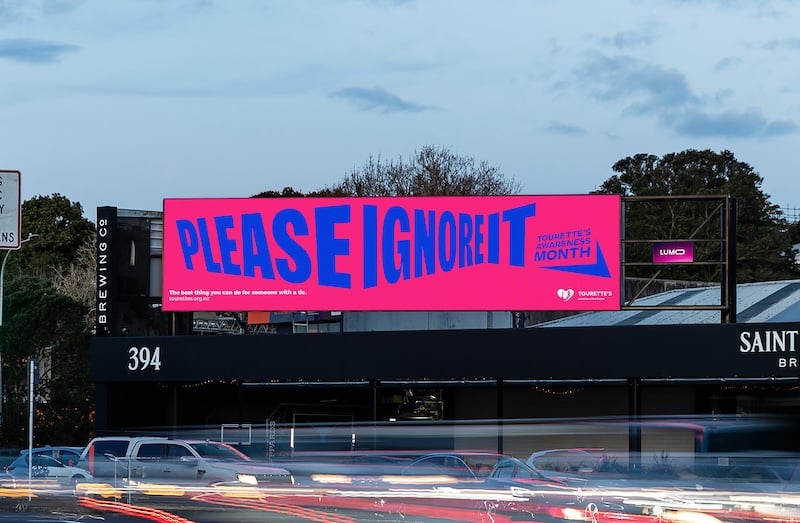
While most awareness campaigns ask for your attention, the latest work from Saatchi & Saatchi New Zealand for the Tourette’s Association of New Zealand is screaming for you to ignore it.
To mark Tourette’s Awareness Month (May 15 to June 15), the association launched campaign: ‘Please Ignore It’, because when it comes to Tourette’s, attention often makes things worse.
It was this simple insight that led the creative team to such an unexpected theme.
Please ignore it
“When someone has a tic, the last thing they want is more attention,” says Emma Henderson, TANZ general manager. “Most people think of Tourette’s as the neurological disorder that makes people swear or shout profanities, which is a form of tic that only impacts 10% of people with Tourette’s. So, when they meet or see someone with other types of tics, they’re often caught off guard and unsure how to respond.
“What they don’t realise is that drawing focus to the tic – whether through staring, pointing it out awkwardly, or falling into awkward silences – can actually increase that person’s stress, making their tics even more frequent or pronounced. That’s why we’re giving people one simple piece of advice: please ignore it.”
Pay cash, not attention
Despite 1 in 100 young Kiwi’s experiencing tics or Tourette’s[1], the syndrome is not considered a disability in New Zealand, meaning it gets zero government funding. Relying solely on grants and donations, the campaign urges New Zealanders to pay cash, not pay attention.
Jordan Sky, executive creative director at Saatchi & Saatchi NZ, says: “People with Tourette’s get unwanted attention 12 months of the year. We wanted to draw attention to the fact they’d rather not be drawing your attention.”
“The reactions can be worse than the tics,” says Henderson. “What many people don’t realise is that the staring, laughing, even awkward silences are far more distressing than the condition itself. This campaign helps normalise Tourette’s in a way that’s empowering, not patronising.”
Right there in the brief
“It’s great when the creative answer to a brief is right there in the brief,” says Steve Cochran, Chief Creative Officer at Saatchi & Saatchi NZ. “Knowing people with a tic would prefer us just to ignore it became the campaign idea. An ad asking you to ignore it means you can’t help but pay attention. This irony makes the message all the more potent, helping educate people about Tourette’s and how to behave around it.”
That tension between asking to be ignored and being impossible to ignore extends into the campaign’s visual language. The campaign’s design reflects the unpredictable, disruptive nature of Tourette’s itself.
Designed in intentionally loud, brash colours, the bold, angular typography takes cues from the jagged pulse-like burst patterns of an EEG brainwave – evoking the neurological activity behind a tic. The resulting design makes the ‘Please Ignore It’ message feel frenetic as though shifting in volume and intensity, mirroring the involuntary motor and vocal tics that define the condition.
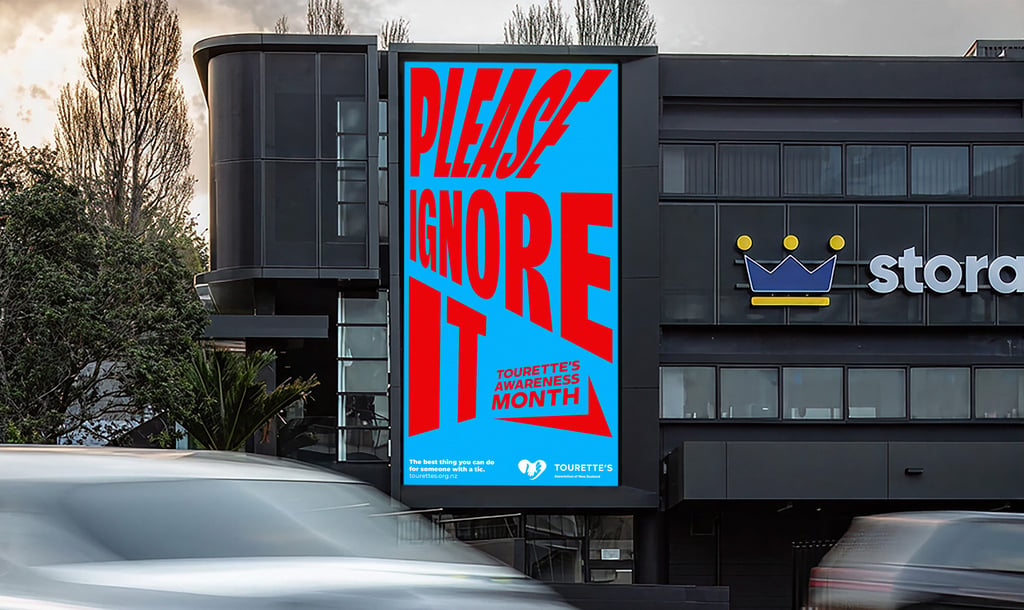
Via TANZ’s media partners – NZME, Mediaworks, LUMO, Go Media, Stuff, oOh! Media and Phantom Billstickers – the ‘Please Ignore It’ campaign will run across radio, digital, outdoor and social.
[1]https://www.rch.org.au/kidsinfo/fact_sheets/Tics/#:~:text=Tics%20are%20sudden%20and%20repetitive,less%20frequently%20than%20in%20childhood.