Get the latest direct to your inbox twice a week. Sign up today. 
Printed media delivers confidence and trust – VMA research

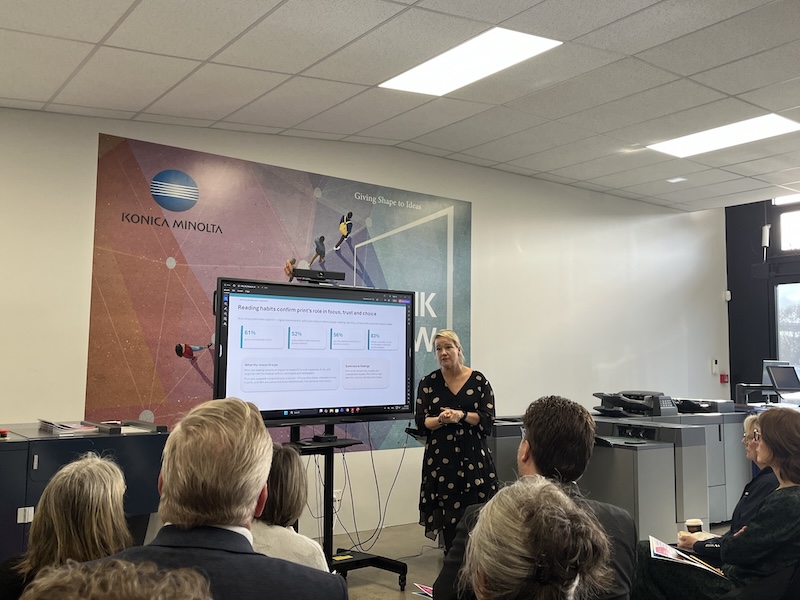
Visual Media Association CEO Kellie Northwood presenting the association's most recent research into physical media.
Print is not disappearing, it is becoming more deliberate, says Visual Media Association CEO Kellie Northwood.
Over the last week, the Visual Media Association (VMA) presented the results of its latest research, looking at how people in Aotearoa engage with physical media channels like magazines and mail.
Where digital channels deliver speed and scale, print and mail deliver confidence, care, retention and choice, says Northwood.
Digital fatigue
One of the most overwhelming findings from the research was the impact that digital channels are having on Kiwis, where 86% of consumers said they feel digitally overwhelmed. This figure was replicated in Australia. People are increasingly looking for ways “to switch off,” says Northwood, and this is something physical media offers them.
This fatigue is seeing people limit their use of tech (57%) and worry about their safety online (51%). The findings also reported that Kiwis get too many emails – on average, 447 unread in their inbox – that one in two delete them without even reading them.
This is where the power of physical media, particularly mail, comes in, says Northwood. It earns attention, trust and action in an overloaded market. The data shows that 53% of Kiwis discover deals via unaddressed mail and 49% are more likely to trust a local business through the mail. People feel like they’re less likely to be scammed via this channel too.
And because this media is physical, it’s likely to be in your vicinity for a lot longer. Here higher retention means higher recall, says Northwood.
People spoken to during the VMA’s focus groups also shared how physical media feels calmer and slower.
Social equaliser
Mediums like magazines continued to be read, with their mastheads gaining them both trust and loyalty. “They’re inspirational, providing you with ideas about how you want to live,” says Northwood.
Civic mail, like a newsletter from your local council, was also seen as being valuable by Kiwis as people appreciate being informed about what’s happening in their area, she adds. They were also more likely to pay attention to it.
This speaks to the strength of the letterbox as a “social equaliser”: many people saw civic mail as creating a sense of inclusivity, says Northwood. “Everyone can have access to it and the cost is borne by the government. You don’t need to have a laptop or internet connectivity.”
Charity mail also stood out for being hugely successful for donor acquisition. This is because it gets viewed more than once as it is talked about and moved around the house.
“The tangibility and tactility of it forces you to take a look. And then people want to do something with that information,” she adds.
Another compelling finding from the data was that 83% of consumers spoke about wanting to have a choice between printed and digital communications – and there had been some cynicism over brands forcing consumers to go paperless.
Perfect marriage
Northwood highlights that the tactility of physical media means that it is easy to come back to unlike the email buried in your inbox or the news article you read online and are never able to find again.
But, she’s quick to add that this presentation isn’t anti-digital, rather an assessment of what print’s strengths are.
“We are an omnichannel universe. What we need to understand is, when is the best time to utilise print and partner with digital? I’ve said it all week and I’ll keep saying it. Print and digital are the perfect marriage. We do not compete with each other.”
There are elements of print that can be added to a campaign without much additional cost but create huge engagement with audiences, says Northwood. She uses Pak’nSave’s 2025 Wrap’nSave campaign as an example, where ads in the NZ Herald also doubled as wrapping paper.