Get the latest direct to your inbox twice a week. Sign up today. 
Why video measurement should reflect how people actually watch – Q+A with Murray Love

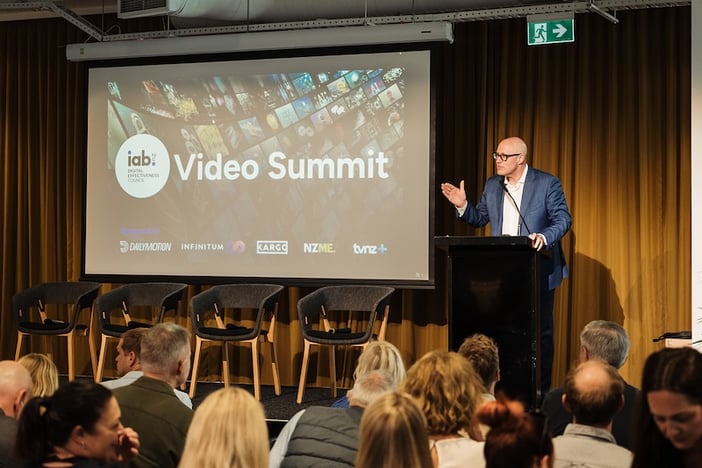
Household viewing habits have changed considerably but reporting metrics are still stuck in the past says Video Futures Collective head of measurement Murray Love. After his keynote at IAB’s Video Summit, he shares with StopPress why measurement should reflect how people actually watch.
StopPress: Video spend in Aotearoa grew 27% last year. Is the industry measuring that investment in a way that reflects how people are watching, or are we still using metrics designed for a different era?
Murray Love: Growth in investment is a strong signal of confidence. But measurement has not kept pace. We are still largely reporting on video using constructs built for a world where the household sat in front of one screen at a scheduled time. That world no longer exists.
In my own household on ANZAC weekend, we consumed content across eight streaming services, with 18 screens available. No single measurement system captured that accurately, and none attributed value where it was actually earned. That is the gap we are working to close.
The direction of travel is clear: start with census-level data from the platforms themselves, the actual impression logs, streaming data, and set-top box data, and use a calibration panel to add the demographic and deduplication layer on top. That approach reflects how people actually watch. Building a large panel and hoping it captures fragmented behaviour is a methodology from a different era.
SP: You are making the case that the household, not the individual, is the right unit of measurement for video advertising. What does that mean in practice for how a brand plans and buys?
ML: In practice it means accepting that a device-level impression is often a household-level impression. When someone watches Netflix on the loungeroom TV, there is a reasonable chance more than one person is in the room. Co-viewing on CTV is real and measurable. We are looking to build a product to capture that. The panel component is built to estimate demographics, duplication, and co-viewing behaviour that census data alone cannot see.
For planners, it means that reach is likely being undercounted in current models. If you are buying against a 25-54 target and an ad is served to a connected TV in a household with two adults in that demographic, device-level measurement counts one. The household-level view counts both. That changes how you think about frequency caps, reach curves, and optimal budget allocation.

SP: What does household viewing look like in 2026? Are homes still sitting down together to watch content?
ML: Yes, and more than people assume. Co-viewing is a genuine behaviour on connected TV. The big screen in the loungeroom has not gone away; it has just changed what it shows. Sport, drama, and music all drive co-viewing, and those are premium content environments.
What has changed is that co-viewing now competes with solo viewing on personal devices, often in the same household at the same time. The challenge for measurement is capturing both. A household might have the main TV showing a live event while two teenagers are watching different content on their own devices. That is five impressions across three screens that current systems would struggle to stitch together correctly.
Data from Vevo is instructive here: more than 50% of their monthly viewers in New Zealand watch on CTV, and that number has nearly doubled since 2020. Music video on the big screen is a shared experience. That is the environment where our attention research showed 78% active attention for a 15-second non-skip ad. When you know co-viewing is happening and you know attention is that high, the case for investing in premium CTV becomes very concrete.
SP: What is the one thing a brand marketer should change about how they plan video campaigns, based on what we now know about household viewing behaviour?
ML: Stop treating streaming as a reach extension for linear and start treating it as the primary environment. At the Video Futures Collective, we now have data that shows premium streaming delivers higher active attention, more than 56% better ROI when you use three or more platforms, and it is currently underweighted in most budgets relative to where audiences actually are.
The work we have done and continue to invest in demonstrates that attention and outcomes should not be ignored.
And the household lens matters here too: if your current model undercounts reach because it is measuring at device level, you are potentially getting more frequency that what you expect.
SP: How can NZ marketers stay on top of video and changes in this space to make sure they are using it to its full potential?
ML: Connect with the work coming out of the VFC. Six of our eight members are active in the New Zealand market, and the research we commission in Australia applies directly in New Zealand because the platforms, the viewing behaviours, and the structural dynamics are very similar. Attention and ROI evidence does not stop at the Tasman.
Engage with the measurement conversation early. The cross-media ad measurement product we are building will create a common language for deduplicated reach and frequency across premium streaming platforms, and the methodology is directly applicable to New Zealand.
SP: Podcasts are increasingly turning their episodes into video so they can be consumed on TVs. What impact do you think this will have on the digital video space?
ML: It adds to the fragmentation story more than it changes it in my view. Add the impact of AI on content production, and we should expect more competition. Connected TV is becoming the default screen for a much wider range of content than it was three years ago. That is good for the attention story because CTV as an environment tends to command higher active attention regardless of content type. But it makes the measurement problem harder, not easier.
Being in the right environment with the right audience in a lean-forward mode is the advantage premium video publishers are able to demonstrate. That evidence base becomes more valuable as the total inventory pool expands.
SP: Looking to the rest of the year and beyond, what trends are you expecting to see in the digital video and streaming ecosystem?
ML: First, outcomes-based measurement going from aspiration to infrastructure. The industry is moving toward real-time, outcome-verified investment.
Further, the cross-platform measurement piece. The VFC is working on this initiative right now. When we talk to agencies and advertisers, this is what they identify as the problem we need to solve.