Get the latest direct to your inbox twice a week. Sign up today. 
Q+A: AI and the future of marketing

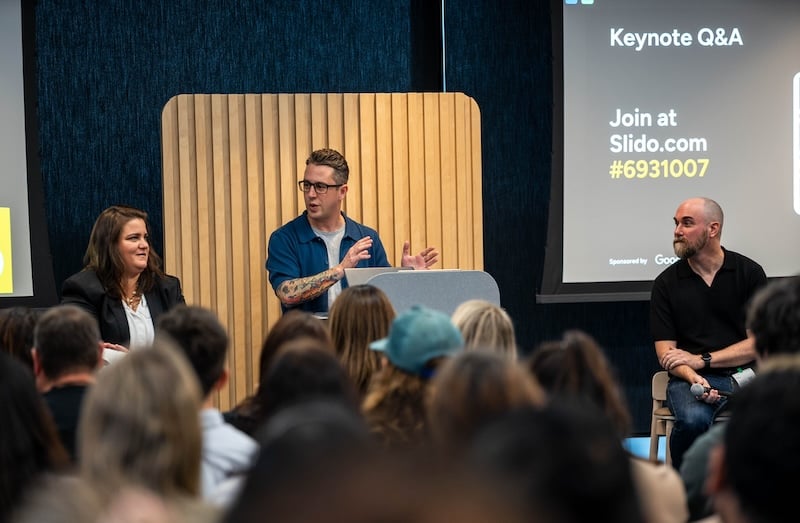
Kellyn Coetzee (left) and Matt Daniels (far right)
At the end of May, IAB New Zealand’s Emerging Technology Council hosted an exclusive event, AI and the Future of Marketing. The two visiting keynote speakers, Kellyn Coetzee and Matthew Daniels, answered some questions on this topic for StopPress.
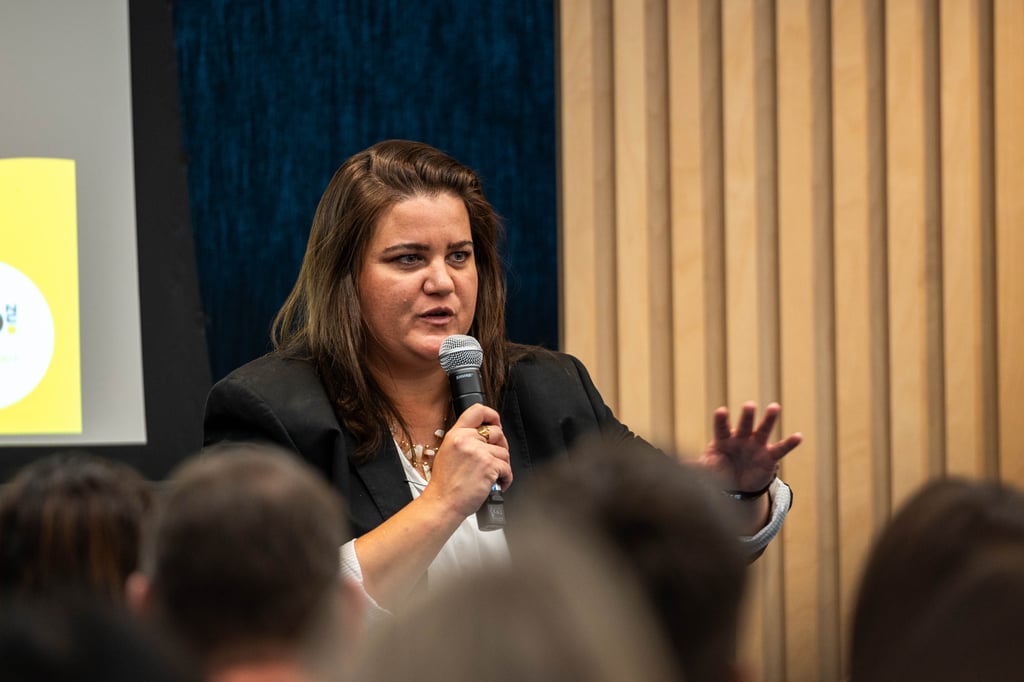
Daniels is chief technology & security officer at XPON Technologies and chief architect at Wondaris Composable CDP. Coetzee is head of digital at Zenith Sydney Australia, co-chair of IAB Australia’s AI Council and a mentor at the Global AI Institute. She is also a standup comedian.
StopPress: How has AI impacted on the marketing and advertising industry over the last few years?
MD: The impact has been significant but also bifurcated. We’ve seen an explosion of new tools and excitement, especially around Generative AI. But many businesses have invested in AI technologies but hit what we call the ‘Activation Gap’ – they have the data and the tools, but struggle to effectively operationalise AI into their day-to-day marketing to derive real value.
KC: Gen AI is the shiny toy that everyone wants to play with, while machine learning has been driving real performance under the hood for years.
ML has quietly reshaped how campaigns run on Martech platforms – everything from bidding strategies to audience targeting to measurement. However, Gen AI has captured imaginations. It’s made AI accessible, changing how we learn, work, and grow.
SP: What are some of the best ways people can avoid being caught up in the hype and use AI in ways that are helpful to them and their workflow?
MD: Focus on genuine utility. The most helpful AI tools are those that augment your existing skills and free you up from repetitive or time-consuming tasks. Think: drafting initial content, summarising long reports, or helping to analyse data sets faster. See if a specific, targeted AI tool can alleviate that pressure, rather than trying to adopt everything new. Remember AI is not a panacea – it’s still a co-pilot.
At the business level, avoid chasing shiny AI objects and instead start with a clear business problem. Then, focus on operationalisation. The most impactful AI implementations often involve proven, repeatable use cases – like smarter audience targeting or AI-assisted media bidding – that consistently deliver ROI.
KC: Stop obsessing over what other companies or your competitors are doing. Many of the companies that jumped in head-first are now quietly backpedalling, and learning some very expensive lessons. Instead, look inward. Future-proof your organisation by building steady, scalable, compliant, people first foundations. And curate and follow trusted advisors in market – watch what excites them, and more importantly, what doesn’t.
SP: How can the industry continue to use AI in a way that is efficient, sustainable and good for the planet?
MD:
- Efficiency is key: Using AI to optimise processes – like smarter ad targeting reducing wasted impressions, or optimising logistics – inherently reduces resource consumption.
- Not every problem needs the largest, most complex model. Sometimes simpler, more efficient predictive models can deliver 90% of the value with a fraction of the computational cost of a massive generative model.
- Partnering with cloud providers like Google Cloud, who are committed to sustainable energy sources and efficient data centers, makes a difference.
KC: Water. It’s one of the least talked-about, yet most critical, resources being consumed in the race to scale AI and we barely account for it.
There’s very little visibility into the environmental toll of training and running these large models, let alone the ongoing footprint of actually using them. Companies building LLMs need to declare their scope emissions so we can at least try to calculate our offsets. Even if the number is scary, we need to know what we’re working with.
SP: What have been some of your key moments in the AI landscape?
MD: The growth in AI accessibility and understanding that AI’s value is only unlocked when it’s deeply integrated into business processes. Seeing clients consistently achieve significant ROI from predictive AI use cases has been huge. The rise of composability in technology stacks is enabling businesses to build flexible, best-of-breed Activation Hubs rather than being locked into monolithic systems. This flexibility is crucial for adapting to the rapid pace of AI.
KC: Ilya Sutskever leaving OpenAI to start SSI Inc. Suddenly artificial superintelligence started feeling a lot less sci-fi and a lot more… imminent. And the first time I used OpenAI’s 0. models – the incredible leap of reasoning capability.
SP: How can the industry stay up to date in the rapidly evolving world of AI?
MD: It’s more about smart navigation than knowing every single new tool. I believe focusing on strong fundamentals is key – good data management, clear strategy, and efficient processes will always serve you well, regardless of the specific AI technology.
- Cultivate a test-and-learn culture: Experiment with new AI approaches but always within a strategic framework.
- No one can be an expert in everything, so forming strategic partnerships with specialists who live and breathe this can help filter the noise and pinpoint genuinely valuable innovations.
- Continuous skill development for your teams, focusing not just on tools but on integrating AI into broader marketing strategy, is a must.
KC: It depends on your department, but start by curating your own circle of trusted AI nerds, people who genuinely care about the space and keep up with it.
If you haven’t already got a little industry brains trust where you can share ideas, learn, and rant a bit, make one.
I follow AI leaders from places like OpenAI, Anthropic, and Google across LinkedIn, X, and podcasts like Marketing Against the Grain. I’ve also got a few strategic Google Alerts and I keep an eye on channels from the AI Institute and X Topic feeds.
SP: How will AI change the industry over the next few years?
MD: I see AI becoming even more deeply embedded as an operational layer within marketing, rather than a standalone ‘special project.’ True hyper-personalisation at scale will likely become the expectation to deliver those tailored experiences in real-time. We’ll also see a significant rise in AI-powered agents and co-pilots assisting marketers directly in their workflows.
Predictive AI capabilities will continue to deepen, offering more sophisticated forecasting and full-funnel optimisation. The focus on ethical, responsible AI and robust governance will be non-negotiable, driven by both consumer trust and regulation.
KC: I’ve built myself a tool that can take a job title or full job description and measure what percentage of those tasks AI can do. It’s never 100% – there will always be a need for a human to guide the tech and input the prompts/desired outcomes. But this report will also show you which tools to use for those AI tasks and from there – what are the skills / capabilities outside of those tasks I can master, that AI won’t.
It also imagines the evolution of that role and the skills required for a future version of that role, the tools and resources to close that gap.
On the big tech side, its about learning to work with the platforms, using your data (that the tech giants don’t have) and your creativity (which they can’t replicate) to gain market advantage. If platforms are becoming AI marketing assistants, marketers need to become AI marketing strategists.
SP: Kellyn, how does your experience in stand up comedy help you in your roles in the AI world – what skills have you found to be transferable across these different positions?
The biggest surprise I had when it came to an applied AI role is the requirement of the skill of influence. To create behaviour change. As a comedian you learn to read a room, to tell a story, to engage people.. Those are all skills I have used to share my passion about AI and turn fear into curiosity, and curiosity into action.
Over the years I’ve learnt how to make complex things simple and accessible. Through empathy meet people at their level, bring them on the journey and have a laugh along the way. Humour is the universal equalizer and in a space where I am expected to always have the answers, and be accurate, comedy is the place where I can play.